Articles tagged with ‘Spaced repetition software’ Page 2
-
Towards a more sensible way of learning to write Chinese
This character learning challenge strives to teach students to learn Chinese characters in a way that makes sense in the long term. While the challenge is over, the principles are still applicable!
Read → -
You can’t learn Chinese characters by rote

My conclusion after years of learning characters is that rote learning is useless. Spaced repetition software is good, but it’s still not enough. If adult foreigners are going to learn to write Chinese by hand, we really need another method. We need mnemonics, we need active processing, we need to quit rote learning and stop using SRS mechanically.
Read → -
Measuring your language learning is a double-edged sword

Spaced repetition software offers a great way of measuring progress, every step forward is recorded and clearly visible. However, this is also a trap, because even though SRS is useful, it’s just a tool, not a comprehensive strategy. Measurable progress is a great help, but only if you use it correctly.
Read → -
Answer buttons and how to use SRS to study Chinese
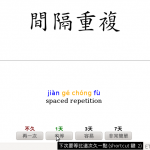
Spaced repetition is very powerful compared to massed repetition, which is why software utilising the spacing effect is growing ever more popular. In this article, I discuss how to review vocabulary using SRS, including how to use the various answer buttons and some other functions commonly available.
Read → -
Chinese vocabulary in your pocket
Having vocabulary with you so that you can study anywhere isn’t merely a handy trick, it’s essential. You don’t want to waste high quality time at home in front of your computer doing something you might as well do in the super market queue or while waiting for the bus. Study the right things at the right time!
Read → -
Dealing with tricky vocabulary: Killing leeches
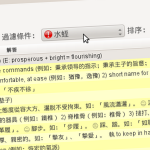
Leeches are words or characters that you keep forgetting and therefore consume much more time than other words or characters. Rather than trying to hammer these words into your brain, a specific strategy is needed to kill the leeches. This article deals with just that, how to handle difficult vocabulary you keep on forgetting.
Read → -
Spaced repetition isn’t rote learning
Spaced repetition might on the surface look like it’s rote learning, but I argue that it isn’t. Firstly, spaced repetition isn’t about learning as such. You’re supposed to use smarter methods to learn the words first and then simply review to keep the knowledge fresh. Secondly, spaced repetition won’t degenerate to rote learning if you are alert and avoid cramming of any kind.
Read → -
Anki, the best of spaced repetition software

Of all the various websites and programs out there to help you learning Chinese, Anki is probably the most important one. There are numerous software to handle vocabulary learning, but in my experience, none of them are as versatile and dynamic as Anki.
Read → -
Spaced repetition software and why you should use it
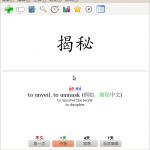
Spaced repetition means that you review words you want to learn in certain intervals to maximise learning efficiency. Since this involves keeping track of much data, a computer program is needed to handle it properly. Spaced repetition software is very powerful and can be used for many things, but learning vocabulary and characters are perhaps the most important applications.
Read →