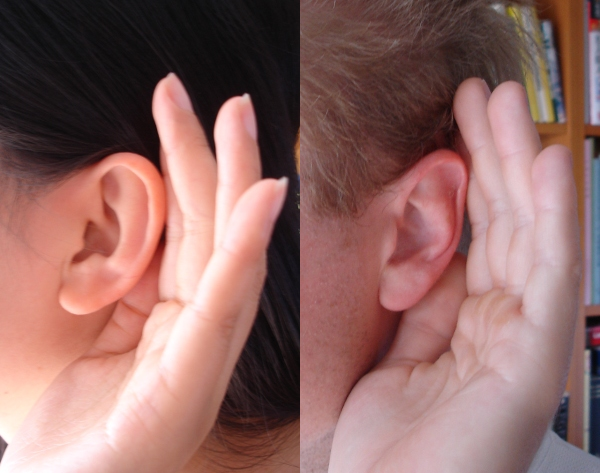
The obvious way to learn Mandarin is to listen to a person speaking the language. The less obvious way is to listen to the person who isn’t speaking in a conversation. What can you learn by listening to the listener?
It might seem a bit counterintuitive to listen to someone who isn’t speaking, but real-life conversations aren’t as tidy as your textbook dialogues.
The truth is that the person not currently holding the floor says quite a lot. Most of this language is completely missing from textbooks!
Tune in to the Hacking Chinese Podcast to listen to the related episode (#297).
Available on Apple Podcasts, Spotify, YouTube and many other platforms!
Improve your Chinese conversations by listening to the listener
In this article, we’re going to explore what it means to be an active listener in a conversation, why it matters, and what specific words or expressions you can use to make your conversations more fluent. The best way to learn this is to listen to the listener!
- A good listener shows that they are engaged and interested
- The importance of playing your role as a listener well
- How to improve your Mandarin conversations by listening to the listener
- Listeners say different things at different times in different languages
- Listener responses in Mandarin: Which expressions to use and when
- Show that you are listening with the most common word in Mandarin
- Acknowledge, confirm, and accept what has been said
- Let the speaker know you’re eager to hear more
- Express admiration or an otherwise positive attitude
- Show surprise at or disbelief of new information
- Show empathy and sympathy when appropriate
- Confirm understanding by echoing what was said
- Signal engagement by trying to contribute to what’s being said
- Laugh when appropriate
- Listen to the listener!
- References
A good listener shows that they are engaged and interested
Being good at conversing in Chinese isn’t only about speaking yourself, but also includes being a good listener.
This includes obvious things, such as maximising your chances of understanding what’s being said, but it also includes playing your role in a social interaction.
As a cognitively overloaded second-language learner, this is easy to overlook!
Among other things, this means showing that you’re paying attention, reacting to what’s said appropriately and inserting small words or phrases that encourage the speaker without taking the floor.
Here are some common examples:
- 对 (duì), “right”
- 哦 (ó), “oh, I see”
- 真的吗? (zhēn de ma), “really?”
You probably know some of these even as a beginner, but there are also other expressions that are at least as common that few students know.
As we shall see, the most common word in Mandarin probably isn’t even in your textbook!
The importance of playing your role as a listener well
These small words and phrases are key to achieving smooth conversations in Mandarin. They show you are engaged and signal your attitude without interrupting the flow.
They are often called listener responses and are ubiquitous in natural conversations in any language. Since native speakers expect them to be there, leaving them out adds friction and tension to a conversation.
Think about English: if you tell me the story of how you started learning Chinese, and I just stare at you in silence the whole time, it will feel extremely awkward. All that’s needed to release the tension is an occasional “oh”, “that’s interesting” or “wow”.
Mandarin works the same way. Some listener responses are the same or similar to English, but many aren’t.
By listening to the listener, you can learn which expressions to use, when they are suitable, and your conversations will be more fluent for it.
How to improve your Mandarin conversations by listening to the listener
So how should you study listener responses?
The best method is focused listening.
Focused input, listening or reading is something I’ve written about before, and the general idea is to select something specific, pay extra attention to that, and collect data for your own usage.
How to improve your Chinese writing ability through focused reading
To do this, you need natural conversations, not textbook dialogues. While non-authentic materials will contain some listener responses, they are both fewer in number and less natural.
Here are some examples of authentic listening materials to use:
- An unscripted podcast
- An interview on a radio show
- A discussion on a TV programme
- A conversation overheard on the bus
Then, listen carefully, but don’t focus on the person who currently holds the floor.
Focus on the other person.
Listen to the listener.
What are they saying?
What are they trying to convey?
Listeners say different things at different times in different languages
English has sounds or words such as “oh” for surprise, “hm” for hesitation, and “mm-hm” for agreement. Some of these are the same or similar in Mandarin, but not all. Using listener responses from one language, even if it’s only a noise, when speaking the other, can cause confusion.
If you want to really dig into this subject, I recommend Jun Xu’s doctoral dissertation (2009): Displaying overt recipiency: Reactive tokens in Mandarin task-oriented conversation.
Among other things, we learn that in English, it’s more common to let listener responses overlap with the speaker, whereas in Mandarin, it’s more common to insert them at natural boundaries.
Another difference is timing and frequency. In one study, Deng (2008) found that Mandarin speakers tend to use fewer listener responses in general, and that they tend to be used more between utterances, rather than continuously while the other person is talking.
In other words, don’t overdo it!
The advantage of listening to the listener is that you will start paying attention to how native speakers do it.
Mimic what they say, when and how.
Improving your Chinese pronunciation by mimicking native speakers
I should also mention that using Mandarin listener responses can lead to confusion in English.
For example, using 嗯 (èn) to indicate that you listen and agree is extremely common in Mandarin but can come across as a grunt in English. I even know of cases where monolingual speakers of English ask outright what all the grunting is about!
Listener responses in Mandarin: Which expressions to use and when
Below, I have collected listener responses, based on both my experience and relevant research (see references at the end).
These categories are somewhat arbitrary and do overlap. They are meant to make it easier to find what you’re looking for, not as a taxonomy for future research.
Please note that these are meant as examples. As mentioned, the preferred approach is to start listening to the listener, not learn phrases from this list (or any other list for that matter).
Here are the categories that follow:
- Show that you are listening with the most common word in Mandarin
- Acknowledge, confirm, and accept what has been said
- Let the speaker know you’re eager to hear more
- Express admiration or an otherwise positive attitude
- Show surprise at or disbelief of new information
- Show empathy and sympathy when appropriate
- Confirm understanding by echoing what was said
- Signal engagement by trying to contribute to what’s being said
- Laugh when appropriate
1. Show that you are listening with the most common word in Mandarin
It’s hard to back this up with data, but one of the most common words in Mandarin is 嗯 (èn). You will hear it dozens or even hundreds of times in a single conversation.
It signals that you are listening, following along, and encouraging the speaker to continue. Native speakers use 嗯 constantly in everyday talk. It can appear alone, repeated, lengthened, or with different intonation.
Its core function is to show attentive presence and keep the floor with the speaker, although length and tone can also add shades like hesitation or mild agreement.
2. Acknowledge, confirm, and accept what has been said
These responses show that you have understood, agree, or accept what was said, and they often move the conversation along smoothly. They can be neutral acknowledgements, confirmations, or acceptance of instructions.
- 对 (duì), “right”
- 好 (hǎo), “okay”
- 是的 (shì de), “yes”
- 没错 (méicuò), “exactly”
- 行 (xíng), “alright”
- 可以 (kěyǐ), “can / sure”
- 嗯嗯 (èn èn), “uh-huh”
3. Let the speaker know you’re eager to hear more
These phrases encourage the speaker to expand on what they have just said, adding detail or continuing the story. In English, you might say “and then?” or “what happened next?”
In Mandarin, there are several very short prompts that achieve the same effect. They are especially useful when you want to keep the other person talking without asking a full question of your own.
- 然后呢 (ránhòu ne), “then what”
- 后来呢 (hòulái ne), “what happened after”
- 结果呢 (jiéguǒ ne), “and the result”
4. Express admiration or an otherwise positive attitude
When somebody tells you something interesting, fascinating or awesome, it’s great to let them know you agree that it is indeed interesting, fascinating or awesome. Here are a few ways to achieve that:
- 真厉害 (lìhài), “impressive”
- 太棒了 (tài bàng le), “awesome”
- 好牛啊 (niú a), “awesome”
- 不错 (bùcuò), “not bad”
Obviously, intonation matters here. If it doesn’t sound like you mean it, it will come across as sarcasm!
5. Show surprise at or disbelief of new information
These sounds and expressions are used to react to something new to you, from merely expressing that it’s new to showing surprise or even disbelief.
- 哦 (ó), “oh I see”
- 噢 (ō), “oh got it”
- 喔 (wō), “oh got it”
- 原来如此 (yuánlái rúcǐ), “so that is the case”
- 这样啊 (zhèyàng a), “I see”
- 是吗 (shì ma), “is that so”
- 真的吗 (zhēn de ma), “really”
- 真的假的 (zhēn de jiǎ de), “really or not”
- 不可能吧 (bù kěnéng ba), “impossible”
- 天哪 (tiān na), “oh my god”
- 我的天 (wǒ de tiān), “oh my heavens”
There is, of course, a range of stronger swear words that might be considered. I advise staying clear of swearing unless you really, really know the person you’re talking with, though.
6. Show empathy and sympathy when appropriate
Just like it’s good to show you think something is great, it’s also important to show care for trouble or hardship.
- 哎呀 (āiyā), “oh dear”
- 辛苦了 (xīnkǔ le), “that was hard on you”
- 真不容易 (zhēn bù róngyì), “not easy”
- 太惨了 (tài cǎn le), “that is rough”
- 听着就难受 (tīngzhe jiù nánshòu), “that sounds tough”
7. Confirm understanding by echoing what was said
These repeats show that you are following closely and want the speaker to continue, or they check that you heard correctly.
In English, this is like repeating a keyword with a rising intonation, for example:
A: “Let’s go to the market tomorrow morning.”
B: “Tomorrow morning?”
In Mandarin, listeners do this very often, both to signal attention and to confirm details. This example is deliberately exaggerated, but in real conversations, people often do repeat what other people have already said to confirm it.
A: 明天早上我们去市场买点菜吧
míngtiān zǎoshang wǒmen qù shìchǎng mǎi diǎn cài ba
Tomorrow morning, let’s go to the market and buy some groceries.
B: 明天早上
míngtiān zǎoshang
“Tomorrow morning.”
A: 对,明天早上。市场在学校对面。
duì, míngtiān zǎoshang. shìchǎng zài xuéxiào duìmiàn.
“Yes, tomorrow morning. The market is across from the school.”
B: 在学校对面吗
zài xuéxiào duìmiàn ma
“Across from the school?”
A: 对,就在对面。我们先过桥再左转。
duì, jiù zài duìmiàn. wǒmen xiān guò qiáo zài zuǒzhuǎn.
“Yes, right across. We first cross the bridge, then turn left.”
8. Signal engagement by trying to contribute to what’s being said
Sometimes listeners show engagement by helping the speaker complete a word or short phrase that is obviously coming next. In the literature this is often called a collaborative completion. It signals close attention and interest, but the listener immediately hands the floor back to the speaker.
For example:
A: 过了那个大… (guòle nàge dà) “passed that big…”
B: 桥 (qiáo), “bridge”.
A: 嗯嗯 (enen), “uh-huh”, 过了桥再右转 (guòle qiáo zài yòuzhuǎn), “after crossing the bridge, turn right”.
In English, it might sound like this:
A: “After you pass that big…”
B: “Bridge?”
A: “Yes, the bridge. After the bridge, turn right.”
Naturally, this requires your listening to be up to par, otherwise you won’t be able to predict what someone might want to say.
Also, be careful not to put words into someone’s mouth that they didn’t intend to say!
Incidentally, this also works in reverse. If you don’t know what to say, try to look as if you’re looking for the right word, then let the listener supply it for you.
This example comes from David Moser’s How to fake sounding like a native Chinese speaker:
You: “And after being so rude, he didn’t even apologize, can you imagine that? The guy is such a…”
Other person: “Jerk.”
You: “…jerk, right. I was thinking to myself, ‘Boy, if I were that guy’s girlfriend, I would really consider… consider…’“
Other person: “Dumping him.”
You: “Dumping the jerk, absolutely…”
9. Laugh when appropriate
Sometimes it’s enough just to laugh along with the speaker to show you share the humour or the mood, without taking the turn yourself. This kind of laughter helps build rapport and keeps the atmosphere light.
For example:
A: 我地图画得像小学生 (wǒ dìtú huà de xiàng xiǎoxuéshēng), “my map looks like it was drawn by a primary school student”.
B: 哈哈,挺可爱的 (hāhā tǐng kě’ài de), “quite cute”.
Listen to the listener!
As mentioned, the best way to learn these sounds, words and phrases isn’t to see them in a list here, add them to your flashcard app and start reviewing them.
Instead, you should listen to the listener yourself. I included examples here mostly to show what I mean and to give you some high-frequency ones you have probably already heard, even if you might not have paid attention to them.
So, next time you listen to a natural conversation in Mandarin, don’t listen to the person holding the floor; listen to the listener!
References
Deng, Xudong. (2008). The use of listener responses in Mandarin Chinese and Australian English conversations. Pragmatics. Quarterly Publication of the International Pragmatics Association (IPrA), 18(2), 303-328.
Clancy, P. M., Thompson, S. A., Suzuki, R., & Tao, H. (1996). The conversational use of reactive tokens in English, Japanese, and Mandarin. Journal of Pragmatics, 26(3), 355-387.
Tao, H., & Thompson, S. A. (1991). English backchannels in Mandarin conversations: A case study of superstratum pragmatic ‘interference’. Journal of Pragmatics, 16(3), 209-223.
Xu, J. (2009). Displaying overt recipiency: Reactive tokens in Mandarin task-oriented conversation (Doctoral dissertation, University of Nottingham).
Editor’s note: This article, originally published in 2011, was rewritten and republished in April 2026.
6 comments
Very True. Here’s a link on this subject from another blog:
http://www.sinosplice.com/life/archives/2006/03/16/learning-east-asian-communicative-grunts
Interesting, I wonder how “East Asian” they are?
I do actually find myself using 对 or Oui in English sometimes. This is a very interesting article because it brings the learner a bit closer to fluency in a way that textbooks won’t.Thank you for this.
I definitely notice that I adopt Chinese noises when I am fully immersed with native speakers. I also personally think that because I make these sounds, some people think my Chinese is “good” (even though there are huge gaps in my abilities, ie. I am awful at writing). I recommend this for anyone who is aiming for “sounding native” quickly and I’m glad you pointed it out. As for how to learn to make approximately the right verbalizations as a listener, I actually realized pretty early I didn’t know how to use 是 and 對 as responses, so I just started to pay attention as I was listening to a lot of radio interviews and watched a lot of TV dramas.
I have been ignoring these words as them come up in my text books. Not trying to waste valuable resources remembering the characters. However, when chatting with people online, I find myself restricted to 啊, and 哎呀.
That being said, I haven’t put much thought to them verbally, simply as listening and speaking goals. However, I have been immersed in a native Chinese country for about a decade, and I just started studying recently. I think I pretty much only really learned these sounds the past 9 years.