 During certain periods of my life, I’ve spent upwards of 80 hours a week learning Chinese. For most people, that sounds crazy; how can you possibly study that much in a week?
To be sure, it is a little bit crazy and requires you to engage with the language full-time, probably in an immersion environment, even though that is not a requirement. But it is not as crazy as it might sound at first. And most importantly, the principles involved are even more useful if you study Chinese part time and lead a busy life!
Tune in to the Hacking Chinese Podcast to listen to this article:
Available on Apple Podcasts, Google Podcasts, Overcast, Spotify, YouTube and many other platforms!
When I say that I spent more than 80 hours per week learning Chinese, I certainly don’t mean that I took twelve hours of classes every day, or that I spent that much time at my desk writing characters. Instead, I mean that everything that I did with the purpose of improving my Chinese added up to more than 80 hours.
That includes speaking with people around me, listening to podcasts, as well as reading everything I could find, such as short stories on my phone, post-it notes pasted all over my apartment and classical Chinese written in my shower. It also includes minute-long sessions of flashcard reviews, chatting with friends online or playing a computer game in Chinese.
Studying Chinese vs. learning Chinese
The words we use to talk about learning Chinese are important, because they are often tied with evaluations of how useful certain activities are. I’m sure there are many students who wouldn’t include listening to Chinese music as “studying”, unless you sit down and actually learn the lyrics, and most tend to put too much emphasis on the role of formal instruction
In my opinion, both are useful. You need as much comprehensible input as you can get, but you also need deliberate practice. I wrote more about the difference between the two in this article:
Don’t get too hung up on the terminology, I bring it up here simply because I want to stress the fact that there’s a wide range of activities that can be useful, but that most language learners aren’t really counting as “studying”, and hence neglect. Don’t do that!
Diversify how you study Chinese to learn more
How much Chinese you learn is ultimately about three things: how much you study, what you’re studying and how efficient your method is. While it’s probably better to concentrate fully on a challenging podcast episode than it is to have a familiar Chinese song on in the background, you don’t really have to choose. Do both. I have written a series of articles about various types of listening activities:
Likewise, while you’ll get more out of a conversation with a native speaker, using Chinese to count the steps up the stairs to your apartment or the number of push-ups you do in the gym, is certainly better than nothing.
The thing is that these activities don’t compete with each other. You can’t watch a TV program while driving to work, but you can sing a long to a familiar song. Similarly, you can’t have a conversation if no friendly native speaker is around, but you can count push-ups in Chinese even if you’re all alone.
So, do both. Do everything. In parallel, at once. The more the better!
Time quality, the time barrel and the forking path
To help you maximise the amount of Chinese you learn, let me introduce three important concepts that I use all the time, not just for learning Chinese:
 Time quality is about doing the right thing at the right time. If you can only spend one hour of focused time studying Chinese at home, don’t waste that listening to Chinese music if you can combine that with your workout routine. Don’t waste high-quality time on low-quality tasks. When you encounter problems, triage your need for help.
 The time barrel is about analysing your schedule in order to maximise time quality and learn as much as possible, even if you’re busy with work, family and other things. Particularly if you’re busy with other things, actually. This builds on the same idea as time quality, but is more practically oriented. There’s always time for learning Chinese if you look at your time the right way!
- The forking path
 discusses a more human approach to the same topic, without the need for meticulous analysis and planning of every waking minute. The core idea is to set a direction as your goal, rather than a specific place to end up in. When you have a choice in what to do, choose the road that leads to more Chinese as often as possible. This method is for those who aren’t too fond of the project-management approach to learning Chinese,
I think most students have plenty of ideas for what to study in the traditional sense: talk to people, attend class, study a textbook, listen to a podcast, read a book, and so on. What many are not so good at is to fit Chinese into their lives in a way that doesn’t require them to sacrifice their families and careers.
Diversifying means you can learn more Chinese without sacrificing other things
The goal here is to spread out whatever can be spread out, combining it with other activities, or chopping it up into smaller tasks that can be completed in gaps between other tasks.
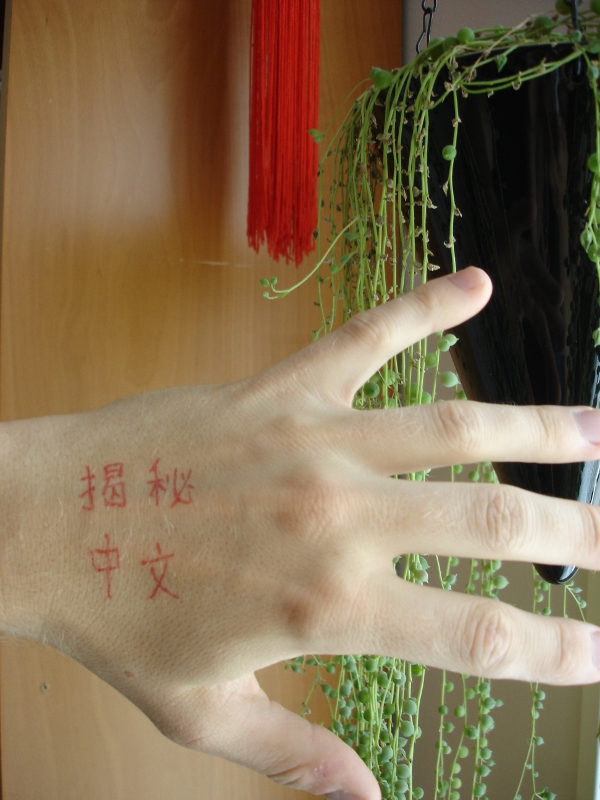
The old trick of writing things on your hands is a good example of this. It means that you might see a difficult character a hundred times over a few days, learning it without any extra time being invested. This is possible because you use time that would otherwise not be used for anything at all.
This is just one example, and if you add up all the various strategies of diversified learning, it’s possible to learn significantly more. Many a little makes a mickle, after all.
Examples of diversified learning
The rest of this post will be dedicated to explaining various ways of doing this. If you have an idea that isn’t mentioned here, please leave a comment below!
 Listen to recorded material – This is perhaps the most powerful method available, because listening is really, really important and you probably don’t do it half as much as you should. I listen to more than a dozen hours of audio every week, without even trying very hard. I listen when I walk, when I cook, when I wash the dishes afterwards, before falling asleep in the evening. And so on. The more the merrier. Of course, I don’t listen very attentively all the time, but that’s not the point. Here are some suggestions if you don’t know what to listen to.
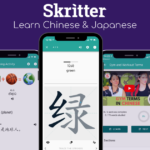 Use spaced repetition software – One of the big advantages with smart phones for Chinese learning is that you can take your vocabulary learning with you. Even if you’re relatively busy, you can probably find 20-30 minutes in a day to review words and characters a few minutes at a time. You can do this with Skritter for handwriting characters or Anki for everything else (including listening), but you can also use paper flashcards.
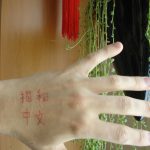 Write difficult characters on your hands – We all have characters that just refuse to stick. One of my worst cases is 疑 (yí), “to doubt”. Rather than spending precious time studying such characters at home or in class, write them on your hand! Using a normal pen, they’re usually gone within a few days, but you will be very familiar with them by that time. You can also write Pinyin and English if you want to. This is one of many methods to kill leeches.
 Tape or write difficult characters and words where you can see them – This is very similar to the above method, but a bit more versatile. Let’s say that you think it’s tricky to remember characters containing 莫 (like 模, 摸, 寞, 幕, 慕, 墓, 暮), well then, make a comparison of these characters using what you know about mnemonics and phonetic components. Put this comparison close to some place where you tend to have extra time, the obvious places being next to your bed, in the bathroom and in the kitchen, just above the sink. You can do this with individual words, too, sometimes in connections with the words themselves, such as attaching the word 柜子 to a cupboard in your kitchen.
 Use a smart phone and appropriate software – There are of course many ways to use smart phones to study Chinese, so it’s rather a platform than a method in itself. We already discussed spaced repetition software and flashcards. Most importantly, a smart phone is the most important device for DIY immersion, because it allows you to always have something to listen to and something to read. You can read everything from short stories to novels, and digital reading has serious advantages for other reasons, too.
- Switching language on your phone or computer – This trick is probably as old as they get, but changing the interface language on your phone or computer is a nice way to become exposed to more Chinese. A warning is in place, however: Even though you will be able to use your phone in Chinese, you will need to be quite good at Chinese in order to learn how new functions work or to troubleshoot your computer. Make sure you can switch to English if you want to, and don’t be afraid to do so if you need to fix something. This method works best in combination with some active studying. Pleco has a feature that lets you look up Chinese characters on your screen, regardless of app.
- Taking notes – To practice writing, try taking notes in Chinese. This is obviously not a good idea when you’re in a hurry, but let’s say your going grocery shopping. Why not write the list in Chinese? If you don’t know all the words, skip some or look them up. Even writing words you think are really easy will improve your overall writing ability. The advanced version of this is to take notes in class or write your to-do list at work in Chinese.
Diversified learning is smart learning
These are just some examples of diversified learning; there are in fact innumerable ways to integrate Chinese into your life and increase the amount you learn as a result. The goal of this article was to get you thinking in this general direction, rather than to point out every single possible variation.
If you’ve heard about or have come up with a good idea I haven’t mentioned, please share it in the comments below!
Editor’s note: This article, originally from 2011, was rewritten from scratch in July 2020.

Tips and tricks for how to learn Chinese directly in your inbox
I've been learning and teaching Chinese for more than a decade. My goal is to help you find a way of learning that works for you. Sign up to my newsletter for a 7-day crash course in how to learn, as well as weekly ideas for how to improve your learning!
17 comments
Thanks for this list, I find a good way is to just splash characters everywhere, I have a wall of post-it notes with a single character on each, so I have the pleasure of peeling it off once it’s stuck in the old noodle. You say that you listen to a lot of Chinese, could you reccomend the best places to find some audio/video I could slap on my IPod. Cheers.
I mostly use audio from RTI (Radio Taiwan International). They have a broad variety of programs, so I get everything from discussions about gardening, teaching children to sing to financial news and political debates. I realise that not everyone is primarily interested in Taiwan, but in case you are, RTI is great. They also have more news with transcripts than you can possible consume.
http://www.rti.org.tw/
I will discuss sources more thoroughly later, but for intermediate learners, I think podcasts are excellent, but try to advance as quickly as you can to get rid of the English (if you’re using ChinesePod for instance).
Wow these are some great ideas!
I knew about listening to recorded material, tape difficult characters where you can see them, & taking notes, but I would have NEVER thought of writing the Chinese characters on your hands!
Some other ideas I came up w/:
– for help w/ pronunciation, listening, you can set a Chinese phonetics song or a dialogue as an alarm/ringtone on your smartphone. I just used a BoPoMoFo (trying to learn Zhuyin) song as my alarm by using the http://www.youtube-mp3.org
– write your to-do list (or for those of you in school, your hw assignments), in Chinese
– I can’t handle w/ EVERYTHING on my computer being in Chinese, so I slowly started changing my Favorites folders into Chinese
Good ideas! One idea that just struck me is that my alarm has a small puzzle you need to complete to make it stop ringing (like tapping the right dots in sequence). It would be cool to replace that with a few flashcards you need to get right before it stops ringing! Embarrassing if it happens in class and you’ve forgotten the characters though. 🙂
Wait, I just remembered I have more:
– count in Chinese in your head where you would normally count in English (for me, that’s flossing, washing face, etc.)
– count in Chinese when stretching before a workout
– watch Chinese pronunciation/listen to podcasts while exercising
– slowly start to change little habits from English to Chinese (e.g. I sing “Happy Birthday to you” in my head while washing my hands w/ soap. Changed it to “祝你生日快樂“。
Warning! Thread hijack: “Mony a mickle maks a muckle” is always what I’ve known – suggesting that mickle = 少 and muckle = 很多.
Interesting! This is what Wiktionary has to say:
I like to practice numbers by reading the numbers on the car license plates around me. You can read them one digit at a time or group them into two or three or however many digit numbers are on the plate. It’s like an endless supply of flash cards at random intervals.