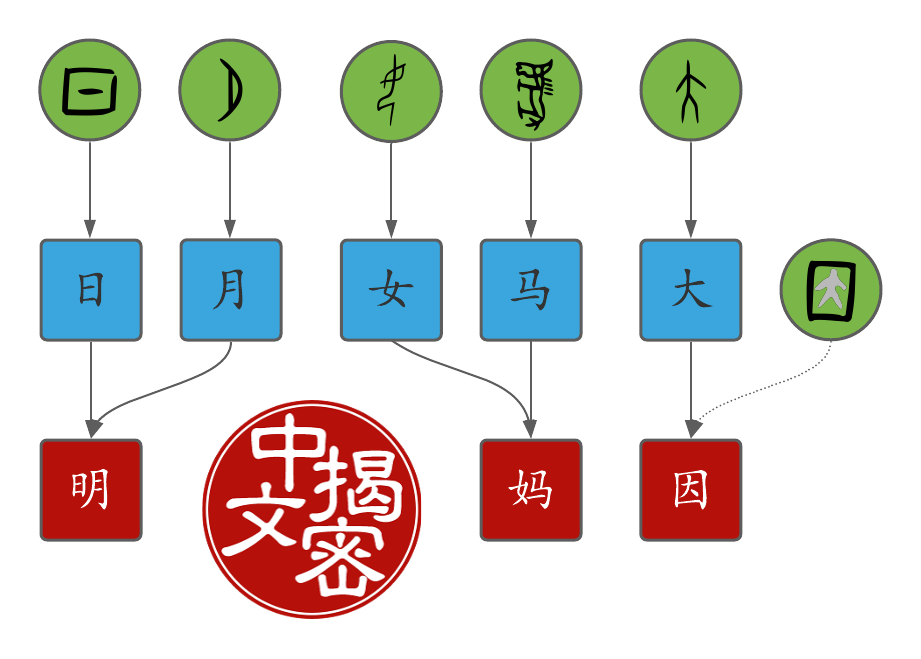
 In the previous article in this series about the building blocks of Chinese, we looked at basic characters and how to learn them. We saw that most of them started out as pictures, which is probably the reason why many people think that Chinese characters are pictures. Some learning materials aimed at beginners also give this impression, choosing to teach only characters that are easy to teach and work well as cute drawings.
The fact that we looked at “basic characters” implies that there’s more to it than that, though, and that a vast majority of characters aren’t pictographs, let alone pictures. In this article, we’re going to look at compound characters in which basic characters are components that contribute to different things to the compound. Before we get started, though, here’s a list of all articles in this series (all have podcast episodes too):
- Part 1: Chinese characters in a nutshell
- Part 2: Basic characters and character components
- Part 3: Compound characters
- Part 4: Learning and remembering compound characters
- Part 5: Making sense of Chinese words
- Part 6: Learning and remembering compound words
Tune in to the Hacking Chinese Podcast to listen to the related episode:
Available on Apple Podcasts, Google Podcast, Overcast, Spotify and many other platforms!
The building blocks of Chinese, part 3: Compound characters
Let’s start by talking about what a compound character is. We saw examples of such characters in the previous article, such as 休 (xiū), “to rest”, consisting of a variant of 人 → 亻 (rén), “person”, and 木 (mù), “tree”, indicating a person resting in the shade of a tree. Two components forming a compound character.
Note that this type of combination is different from another example we also looked at in the previous article: 中国 (Zhōngguó), “China”, which is a word consisting of two characters put next to each other. They are not combined into a new character, though, and each character is linked to one syllable in the spoken word Zhōngguó. You can also see that each character takes up the same square space. In contrast, 休 (xiū), “to rest”, is a single character read with a single syllable in a single square space. We will talk about words like 中国 (Zhōngguó), “China”, later in this series, but let’s focus on compound characters first!
Compounds usually consist of two components, and of course they aren’t combined haphazardly, as that wouldn’t make any sense. It can be helpful as a learner to understand why a compound character looks the way it does, or more precisely the function of each component in the character. For example, I think most people would agree that thinking of 休 (xiū), “to rest” as a person resting under a tree makes the character easier to remember. Both components here relate to the meaning of the compound character and it’s easy to form a mental picture as well.
Let’s have a look at three more high-frequency compounds:
- 好 (hǎo), “good”, consisting of:
- 女 (nǚ), “woman”
- 子 (zǐ), “son; child”
- 妈 (mā), “mother”, consisting of:
- 女 (nǚ), “woman”
- 马 (mǎ), “horse”
- 因 (yīn), “reason; cause”, consisting of:
- 囗 (wéi), “enclosure”
- 大 (dà), “big”
As we shall see, these three compounds are all different, and we will now look at them one by one to see what they can tell us about the Chinese writing system and how to learn it efficiently.
好: Meaning + meaning compounds
It’s not hard to imagine how compound characters came about. As the writing system developed, it was natural to have characters for some things, but not others. Maybe there was a character for “woman” 女 (nǚ) and a character for “child; son” 子 (zǐ), but there was no character that meant “good”.
This is not strange, because drawing a picture of a woman or a child is relatively easy, but how would you draw a picture of “good” so that other people would understand that that’s what you meant?
One way to do it is by association. If you put two things together that are “good”, this compound can then be used to mean “good”. Maybe you would have picked something else than “woman” and “child” for this purpose, but those are the characters the ancient Chinese used, hence we have the character 好 (hǎo), meaning “good”.
Once you know that 休 (xiū), “to rest” is a compound of this kind, it’s easy to remember it, even though that doesn’t necessarily mean that an uninitiated learner might have guessed the meaning based on just the components. I mean, maybe “person” and “tree” together could mean “woodcutter” or “wooden figurine”? Still, knowing the origin of a character like this makes it much easier to remember it.
Sometimes, the association is so easy that it is possible to figure it out just by looking at the components. What do you think 林 (lín) means, consisting of two trees 木? Yes, that’s right, a group of trees, or “forest”. We also have 森 (sēn), which also means forest. Together, they form the two-syllable word 森林 (sēnlín), which is the most common way to say “forest” in modern Mandarin, but we’ll save word formation for later and stick to single characters here.
Here are a few more meaning + meaning compounds that you will encounter very soon if you haven’t already:
- 明 (míng), “bright”, consisting of 日 (rì), “sun”, and 月 (yuè), “moon”. Two bright objects combined to give the meaning of “bright”, also used in words like 明天 (míngtiān), “tomorrow”.
- 间 (jiān or jiàn), “between; gap”, consisting of 门 (mén), “door”, and 日 (rì), “sun”. The shun shining in through a gap or opening in a door. First tone means “between; room”, fourth tone means “opening; to separate”.
- 男 (nán), “male”, consisting of 田 (tián), “field”, and 力 (lì), “force”. Originally, 力 showed a plough, and traditionally, ploughing fields was associated with men.
- 安 (ān), “peace; quiet”, consisting of 女 (nǚ), “woman”, and 宀 (not pronounced on its own), “building”. The original meaning is to sit quietly, which is then extended to mean peace and quiet in general.
- 名 (míng), “name”, consisting of 夕 (xī), “evening”, and 口 (kǒu), “mouth”. Names are what we say to identify each other at night when it’s too dark to see.
妈: Meaning + sound compounds
As we have seen, it’s reasonable to combine the meaning of “woman” and “child; son” to mean “good”, or to use several trees to mean “forest”. Once you’ve seen a few examples like this, it’s easy to think that all character compounds are like this, but this is actually not the case. These are in fact quite rare!
Take the character 妈 (mā), “mother”, for example, which consists of 女 (nǚ), “woman”, and 马 (mǎ), “horse” (馬 in traditional). Did the ancient Chinese somehow associate mothers with “woman” and “horse”?
Well, “woman” has an obvious connection to “mother”, but “horse” doesn’t. Something else is going on here, which becomes clear if you look around a bit and include a few more characters.
Have a look at these additional examples:
- 吗 (ma), a question particle used in yes/no questions, consisting of:
- 口 (kǒu), “mouth”
- 马 (mǎ), “horse”
- 码 (mǎ), “number; code”, consisting of
- 石 (shí), “stone”
- 马 (mǎ), “horse”
- 骂 (mà), “to scold; to curse”, consisting of
- Two 口 (kǒu), “mouth”
- 马 (mǎ), “horse”
As you can see, 马 (mǎ), “horse”, appears in all these characters, yet it’s not clear how it’s related to the meaning of any of them. Can you spot something else these characters have in common? Can you figure out what function 马 (mǎ), “horse”, has in these characters? Look over the list again and see if you can spot the pattern before reading on.
The answer, which I hinted at in the heading of this section, is that all the characters are pronounced “ma” (but with different tones). So, the character 马 (mǎ), “horse”, is included in these compounds not because of what it means, but because of how it’s pronounced!
A Chinese alphabet?
It’s not hard to imagine how such characters came to be either. Remember, the spoken language comes first, and the ancient Chinese of course had spoken words for all sorts of things before they saw any need to write them down. Since these words already exist, it’s very convenient to rely on their pronunciation when coming up with characters for them, instead of trying to come up with clever associations like we did for 好 and 休 all the time.
One way to do it, which is a step towards an alphabet like the one we use, is to just use the same written character to mean anything that is pronounced like that character. In this case, this would lead to the character 马 losing its original meaning “horse” and instead simply represent the syllable “ma”. The step from there to using it as we use the letter “m” is not big.
That’s not what happened in Chinese, though, and it’s what makes learning to read and write Chinese such a unique challenge and fascinating journey. 马 was not used on its own to indicate other words that were similarly pronounced. Instead, it was included in compounds along with another component that referred to the meaning, such as 女 (nǚ), “woman”. So in a character like 妈 (mā), “mother”, 女 (nǚ), “woman” hints at the meaning, and 马 (mǎ), “horse”, hints at the sound.
Sound is the key to most Chinese characters
This is in fact how almost all Chinese characters came to be. Like I said earlier, it’s easy to think that most characters are pictographs or even pictures, which is true for a lot of basic characters, but the more you learn, the rarer these basic characters become. After a while, almost all characters you encounter contain a sound (phonetic) component and a meaning (semantic) component. These characters are called phono-semantic components and are extremely important.
Of course, these compounds were created a long time ago, and the spoken language has changed a lot since then and the characters themselves have evolved, which is why the tones don’t match in the above examples. In fact, the tones almost never match.
Sometimes more than the tone has changed and other parts might be different too. In some cases, the modern pronunciation seems completely unrelated to the pronunciation of the sound component! For example, in 他 (tā), “he”, 也 (yě), “also”, is actually the sound component, but as I think you’d agree, tā and yě doesn’t sound even remotely the same in modern Mandarin.
Unless you’re familiar with the pronunciation of very old forms of spoken Chinese, it can be impossible to figure this out on your own. You don’t have to, of course, that’s why you got hold of the Outlier Linguistics Dictionary of Chinese Characters after I recommended it in the previous article, right?
If you want to know more about phonetic components and sound in Chinese character,s I suggest you check out these two articles, which also contain many more examples:
Phonetic components, part 1: The key to 80% of all Chinese characters
Here are a few more meaning plus sound compounds from the above articles:
Sound component: 青 (qīng), “green; blue”
- 请 (qǐng), “please, to ask”
- 清 (qīng), “clear”
- 情 (qíng), “emotion”
- 晴 (qíng), “fine (weather)”
Note that they all share the same phonetic component and are all pronounced in similar ways, even if they mean completely unrelated things.
Phonetic component: 羊, yáng (sheep)
- 洋 (yáng), “ocean”
- 样 (yàng), “manner; appearance”
- 养 (yǎng), “to support, to raise”
- 氧 (yǎng), “oxygen”
Again, pronunciation is the same except for tones. Like I said, this is not always the case, but paying attention to phonetic components can still me immensely helpful!
因: Not as easy as it might seem
Even though it’s true that Chinese characters have logic to them, and that by understanding the components and their functions, learning the characters becomes much easier, let’s not hide the fact that Chinese characters have evolved over thousands of years and can be very hard to make sense of. In some cases, not even the experts agree on the origin of a character or what function a component has.
Let’s have a closer look at 因 (yīn), “reason; cause”, consisting of 囗 (wéi), “enclosure”, and 大 (dà), “big”. Is this a meaning + meaning compound? Or maybe a meaning + sound compound? From a learner perspective, it could be either, or something else entirely, you can’t know that just by looking at it.
Checking this character in the Outlier Linguistics Dictionary of Chinese Characters, we learn that both components are related to the meaning, but that we need to introduce a different kind of semantic component to fully make sense of this character. A form component is a component that is included because of what it depicts. That sounds very similar to a meaning component, but it is a bit different, and 大 (dà), “big”, is the perfect character to illustrate this with.
The character 大 shows a person with outstretched arms, and originally meant “adult human”. Over time, it came to mean “big” too, and soon the original meaning faded away. Today, when used on its own, 大 means “big”, not “adult human”. But remember, the compound characters we are talking about here were created a long time ago, so in these compounds, 大 almost always refers to a person, not “big”. Form components are components that refer to what the component depicts, rather than what it means. In this case, 大 means “big”, but it’s used for what form it original depicted, i.e. “adult human”. So the 大 in 因 is best thought of as “human”, not “big”.
In this article series, I have deliberately dealt with meaning and form components together, as I don’t think the distinction is important enough for casual learners to pay too much attention to beyond what I’ve said here. If you really want to dig into this properly, Outlier Linguistics offers a course about Chinese characters that tells you everything you need to know (and probably a bit more).
But we’re not done with 因 yet! 囗 (wéi), “enclosure”, was originally clothes wrapped around the human inside, and the original meaning of 因 was “clothed person”. This is not hard to see in some older forms (from Wiktionary 因):
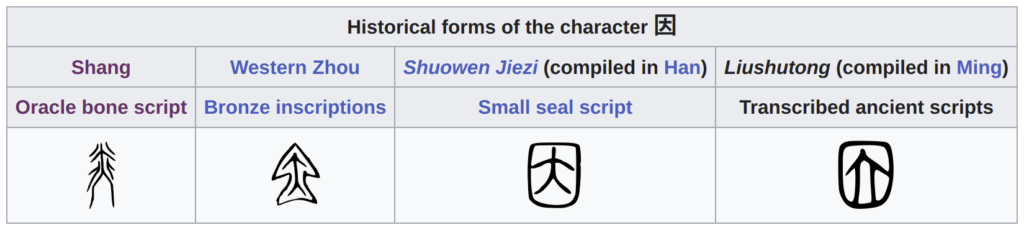
The character came to mean “rely on”, which then came to mean “reason; cause”, a chain of extensions that are far from obvious in retrospect. If you simply assumed that the basic meanings of the components held the key to the compound itself, you’d be wrong!
Learning and remembering compound characters
As we have seen, some compound characters are very easy to learn, provided that you know the building blocks. That is after all the whole point of this series of articles: if you learn the building blocks, you’ll find that most compounds are easy to learn. Some characters are easy combinations of basic characters, such as 好, and linking the components together will form a strong memory of the written character. Other characters, such as 妈, include certain components not because of what they mean, but because of how they are pronounced, and these also make sense, albeit in a different way.
In the next article in this series, we will look closer at how to learn and remember these compounds. You know how the background knowledge you need to make sense of them, but as anyone who has tried learning at least a few dozen characters can testify, this is not enough. Keep reading the next article in this series:
https://www.hackingchinese.com/the-building-blocks-of-chinese-part-4-learning-and-remembering-compound-characters/
Tips and tricks for how to learn Chinese directly in your inbox
I've been learning and teaching Chinese for more than a decade. My goal is to help you find a way of learning that works for you. Sign up to my newsletter for a 7-day crash course in how to learn, as well as weekly ideas for how to improve your learning!
25 comments
The character 好 is a good example of a beginner level word where one could use your method.
女 + 子
woman + child = good
I was just told about your site today by a friend and I find it really fascinating!
I’m in asituation where I’ve been studying chinese before (and forgot most charecters) but is quite good in the day-to-day spoken chinese. Now I want to step up to the next level and hope to become really good in chinese for real.
Your site is just what I need to find the tools and inspiration to get started again, thanks!
OMG this post just saved me massive pain. I just started learning to write characters 5 days ago and already have two “man in a hat” mnemonics. Although I try to follow the etymology already, I’m going to force myself even more in that direction.
I did something like that, each component was a single object (rather than abstract things or actions) so I could really see them in my mind, so creating the stories is pretty much like playing a point and click game when you gotta several common objects and need to combine them in creative ways to solve a puzzle.
I also put the stories in different themes to learn the readings, each reading being a different theme, most of the themes were games that I played or movies/animes that I watched, I doesn’t need to be very detailed, as long the theme is clear it’s enough (e.g. one of my biggest themes was “KAN”, it had more than two hundreds of kanjis in it, I used generic images about Gengis Khan and his time, and although I don’t know any history detail I could make the memonics just as well).
I have been using this method without knowing there was a literature about it, and it works very well… the most important thing is that you personalize “your” story behind the character.
eg. 愁 … your explanation makes sense and it’s probably the most correct one, but for me it wasn’t easy to remember.the day after I couldn’t come up with the link between the 3 components. So I I looked at the three components of the character again and made up my own one “if your grains 禾 are all set into fire 火,well then in your heart 心 you must be very worried”.
… this is just to say that everybody can use this method, with a bit of creativity!!
thanks for the blog, it’s great!
Actually, there’s research into mnemonics that supports your experience, i.e. that mnemonics created by the student him/herself are more efficient than those created by others and “learned” so to speak. I just want to point out that my mnemonic for 愁 isn’t “correct” at all, it’s just the way I think about it!
This system works. However I am wondering how to deal with those characters that have multiple meaning unrelated?
I mean those characters that need a second character to be clarified.
If you haven’t seen them in context (i.e. you just note that they have multiple readings in a dictionary), ignore the extra readings until you actually encounter them. I haven’t found these characters very hard (apart from telling them apart really quickly while reading aloud). If I need to, I simply combine more than one concept into each mnemonic. If they are related, this isn’t all that tricky. For instance, 長 means both “long” and “to grow”, which are obviously related, so imagining something growing and becoming longer is enough. Of course, you need to remember that both of these are actually different words, but that will come fairly naturally once you’ve seen them a lot.
Yep, thanks. I was adding characters to my Anki deck. As you said I just write one/two meaning that I already encountered.
Cheers!
覬 May I suggest: “Gee! (with a sigh to indicate the third tone.) I wish that mountain of beans that I see over there were mine.”
Täglich Chinesisch – German site explains more than 2000 Chinese characters …
I am loving all the information on your site and plan to buy the ebook very soon! I’m newbie, fresh off the boat newbie. I’m learning the radicals first with your anki deck. Can you tell me what characters to start learning for a newbie? Should I start with HSK basic/elementary list? They claim to be the most common. Would you recommend I learn a bunch of those “common” characters before starting to learn words – learn the maths as you say? I wish you had a list for those too 🙂 Any recommendations would be great! I also plan on signing up for ChinesePod soon. However, before then I don’t quite have a vocabulary collection apart from the “most common words in any language” list I have for past language studying. Would you recommend I use that for my beginner vocab list? Sorry, coming from learning Japanese which was much worse and I spent way too much time figuring how the best WAY to learn instead of actually learning. So far, Chinese seems easier – much easier. I just want to start strong. Thank you!!
Hi! Get a textbook instead. I don’t recommend using word lists for learning new words because it will be out of context and even if you could add that yourself, it will take way too much time. A good textbook will do that for you. My textbook familiarity is a few years out of date, so I don’t dare recommend anything in particular, but look around on the internet and see what people recommend!
I found the page talking about Radicals very useful. I’ll make sure to keep it in mind!
I using this for my homework and it kinda help thank you
Glad to hear it helped! I think you’ll find that the more you pay attention to components in compounds, the easier it will be to pick up new characters in the future!
Is anyone familiar with SmartHanzi? This is a free desktop and mobile app which I have been using extensively. It uses English/French/German dictionaries and provide stroke order for starters.
But the real thing for me is that it makes uses of the English edition of Wieger’s Chinese characters (French also available), and Kanji Networks (Lawrence J. Howell) to explain the origin of characters.
–> I’d really like to know how it compares to Outlier for example 😉
There’s also the Grand Ricci dictionary available for Pleco, but I guess that’s just for French speakers, that would explain why it isn’t listed in resources, right?